Raqq
Building a local-first study workspace for source integration, durable notes, and spaced repetition.
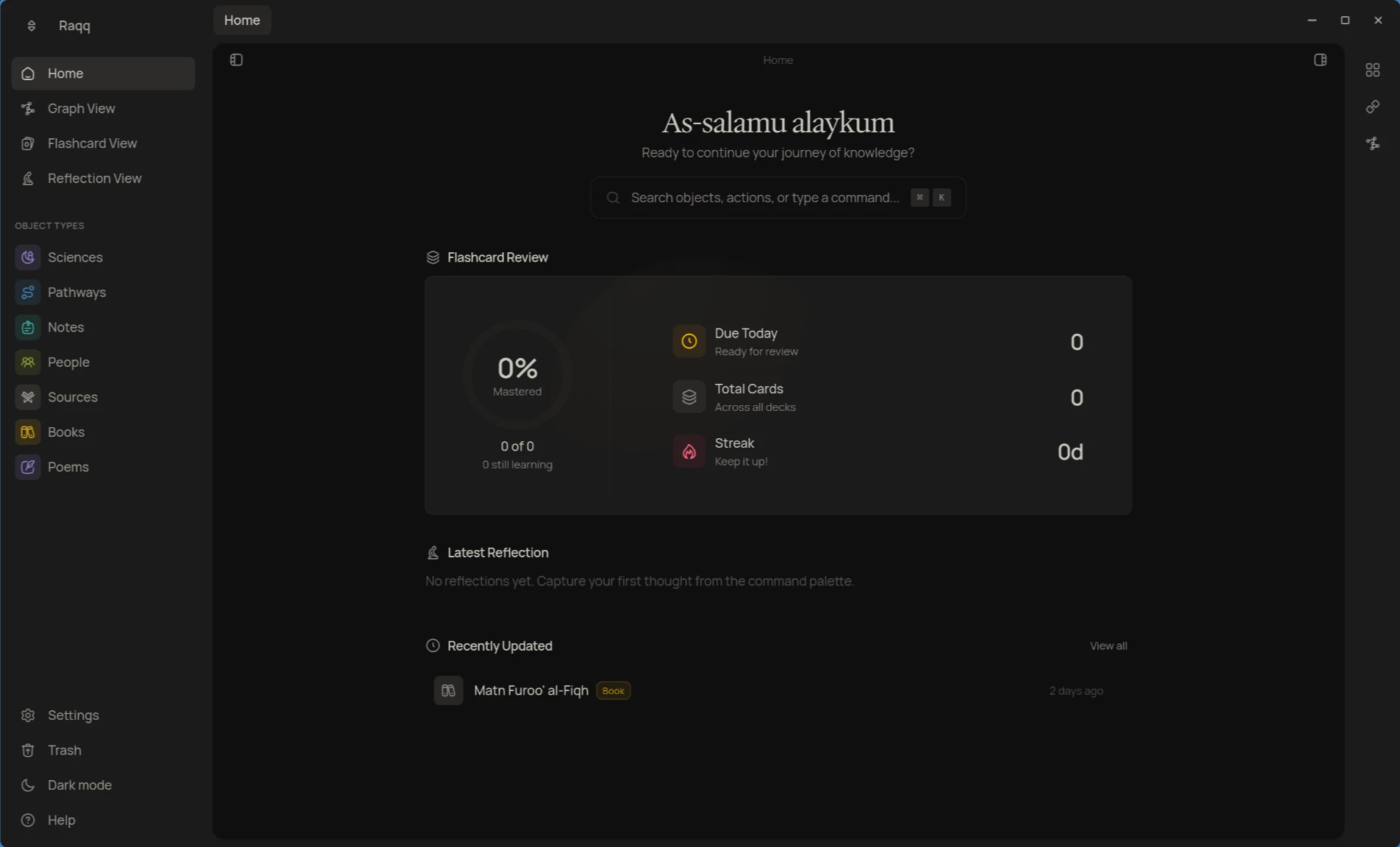
Intro
Raqq is a local-first study workspace for serious students of knowledge. It began with a problem that gets worse over time: books, source texts, people, concepts, notes, and past reflections become harder to keep connected as a body of study grows.
Saving another note is easy. Preserving its context is harder. You need to know what you read, where an idea came from, what it connects to, why it mattered, and when it should return for review.
Raqq is still in development. The goal for launch is a durable workspace that connects authored notes to source material and turns important knowledge into scheduled review.
My role
I am designing and building Raqq end to end as a desktop product.
- Product direction and information architecture
- Interface and interaction design
- Desktop application development with Tauri, React, and Rust
- Local persistence and SQLite data modelling
- Reading, note-taking, relationship, and review workflows
The current work is focused on the local reading and note-taking foundation. Source integration and spaced repetition remain launch requirements, not finished claims.
Solution
Raqq treats study material as connected objects rather than a folder of interchangeable documents. Notes, books, pathways, people, poems, reflections, and sources each retain their own structure while sharing a common relationship model.
The note editor keeps authored thinking beside properties and relationships. Content stays readable as Markdown on disk instead of being locked inside an account or proprietary cloud database.

Reading is part of the same workspace. The book view keeps source material close to the notes and relationships that come from it, reducing the gap between reading something and preserving why it mattered.


Process
I started by separating durable study needs from the conventions of general note-taking apps. A serious study workspace needs provenance, relationships, and review. Capture alone is not enough.
That led to a desktop-first, local architecture. Authored content lives as Markdown on disk. SQLite mirrors metadata for fast search, properties, and relationships, while a Rust core handles the storage layer. There are no accounts, cloud sync loops, or telemetry.
The sequence matters. I am stabilising reading, writing, object types, and local persistence before adding the complete source-integration and spaced-repetition workflows. Review only becomes useful when the material underneath it has reliable context.
Lessons
Local-first is a product constraint, not a storage preference. Keeping Markdown readable on disk affects identity, metadata, search, relationships, and every workflow built on top of them.
Study tools also need stronger object boundaries than general note apps. A person, book, reflection, and source may all contain text, but treating them as the same document removes useful context.
The final lesson is about sequence. Spaced repetition is tempting to build early because it is visible and concrete. It only becomes durable after source material, notes, and relationships are stable enough to support it.